
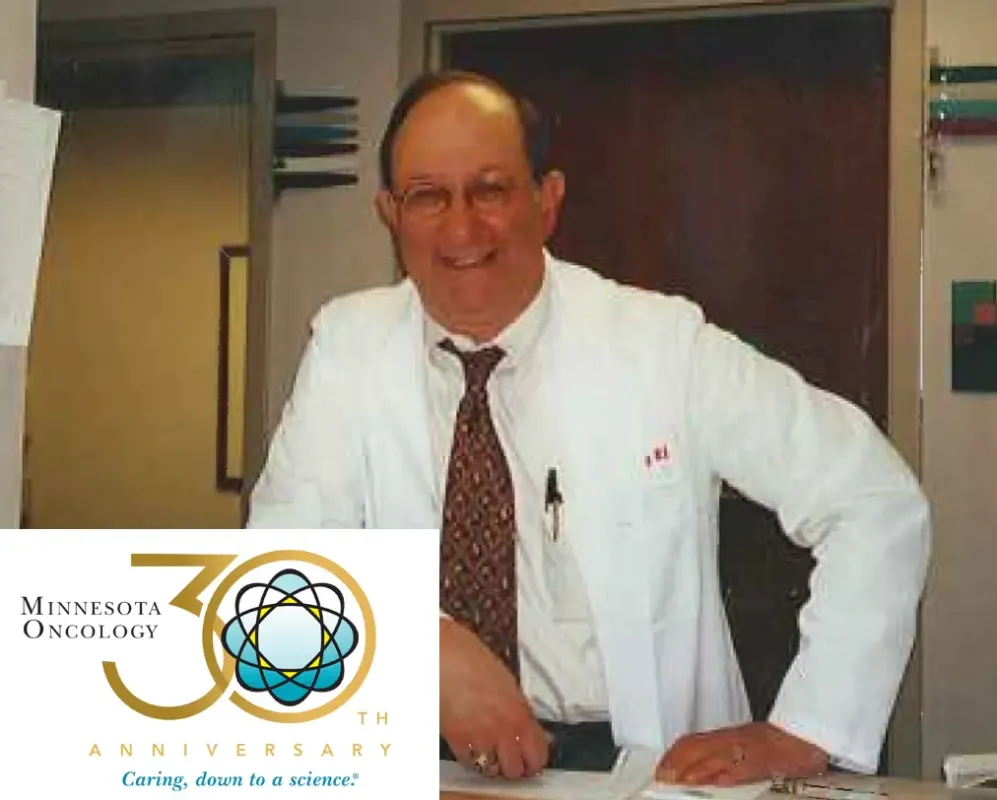
As Minnesota Oncology celebrates 30 years of care, we are shining a light on the inspiring stories of those who helped shape our legacy. Among these pioneers is Dr. Burt Schwartz, a founding member whose career has been integral to our growth and success.
Dr. Burt Schwartz along with Dr. John Brown and Dr. Ignacio Fortuny, began their journey in a modest office in downtown Minneapolis. At a time when the oncology community was small and close-knit, the trio shared a vision to revolutionize cancer care in the region. "We were part of medicine groups, but the complexity of oncology required a more focused approach," said Dr. Schwartz.
Realizing the need in the region for focused oncology care, they reached out to like-minded professionals, forming a collaborative group that became Oncologic Consultants, where Dr. Schwartz served as president. A few years later, the group merged with two St. Paul-based oncology practices to form Minnesota Oncology Hematology, P.A. – bridging both sides of the river and setting the foundation for what is now Minnesota Oncology.
“We wanted to create a community where oncologists could share resources and expertise, ensuring patients received the best possible care," Dr. Schwartz explains. “It happened because people shared a common vision – our success was built on a shared vision and collaboration."
Dr. Thomas Flynn, another Minnesota Oncology founding provider and past president, credits Dr. Schwartz’s vision and leadership as the driving force that brought the three groups together, and the subsequent partnership with Physician Reliance Network, which is now The US Oncology Network.
Dr. Schwartz was the first president of the newly formed practice and served in that role for many years. Throughout his career, Dr. Schwartz witnessed remarkable advancements in oncology. From the early days when treatment options were limited, to the present, where targeted therapies and immunotherapy offer new hope, the landscape has transformed dramatically.
"Understanding the genetic mutations that drive cancer has been pivotal," Dr. Schwartz said. "We're now able to tailor treatments more specifically, improving outcomes and extending lives."
According to Dr. Schwartz, one of the most significant contributions the practice made for cancer patients was moving chemotherapy from hospitals to the clinic setting, a change that improved patient care and reduced costs. "This shift allowed us to treat more patients efficiently while maintaining high standards of care," he reflects. "In addition to in-clinic infusions, we also developed comprehensive support systems, ensuring that patients received holistic care beyond just medical treatments."
Dr. Schwartz stepped back from Minnesota Oncology to help take care of his wife of 50 years during her battle with breast cancer. He continued to fill in at Minnesota Oncology as needed and helped run a hospice team at a different organization as volunteer before formally retiring about six years ago.
Reflecting on his journey, Dr. Schwartz emphasizes the lessons he learned from his patients. "Taking care of cancer patients has taught me what truly matters in life," he shares. "Their strength and resilience are a constant source of inspiration."
As Dr. Schwartz looks back on his career, he expresses gratitude for his colleagues and the community they built together. "Seeing an idea grow into one of the premier oncology groups in the country is incredibly gratifying," he said. "Our commitment to high-quality care and empathy has always been our guiding principle. We’ve continued that tradition in hiring of high-quality physicians and providing excellent care.”
As Minnesota Oncology celebrates this milestone, we thank Dr. Schwartz and all those who have contributed to our legacy. Together, we look forward to a future of continued innovation and compassionate care.
Share
Categories
Tags
Recent Posts

Understanding your breast cancer risk can help you make informed decisions about screening and early detection. Learn about risk factors and personalized breast cancer screening options.

Learn about the common signs and symptoms of lymphoma and leukemia, including fatigue, swollen lymph nodes, unexplained bruising, frequent infections, fever, and other changes that may warrant medical evaluation.
Learn about thyroid cancer, including common signs and symptoms, risk factors, and treatment options. Learn when to talk with your doctor about concerning symptoms.