
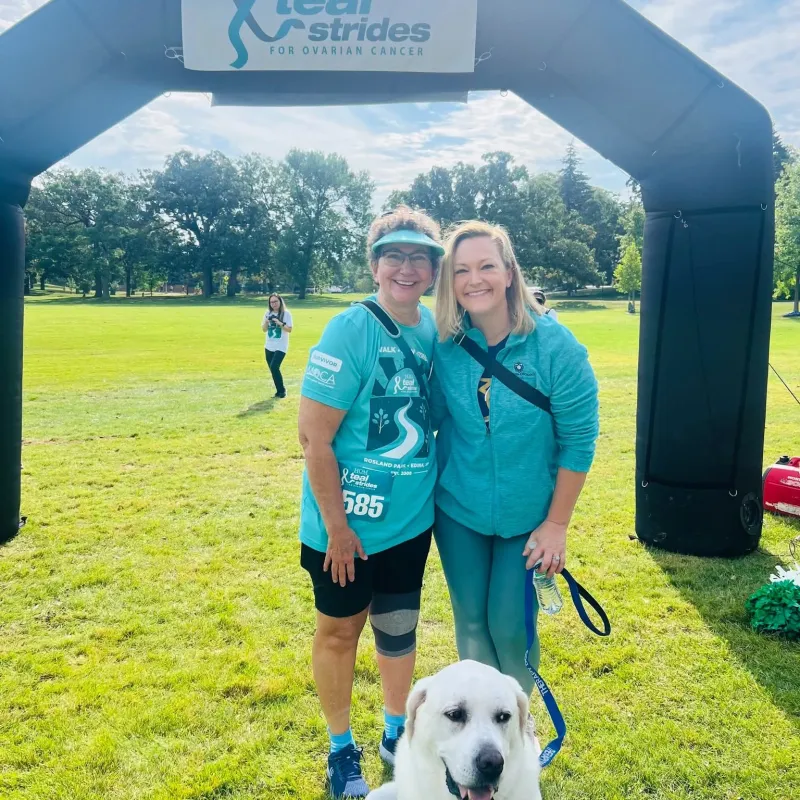
Julie Smith has always believed in the power of science.
As a former life science and earth science teacher, she spent many years helping students understand research, discovery, and the importance of evidence-based learning. That belief would later guide her through one of the most difficult chapters of her life.
A Life-Changing Diagnosis
In June 2023, Julie was diagnosed with low-grade serous ovarian cancer (LGSOC), a rare and slow-growing form of ovarian cancer.
Her diagnosis came during an already emotional time as her sister Jean had recently been diagnosed with cancer as well.
“Jean was diagnosed first,” Julie said. “Over the course of three months, she had experienced three bouts of 24-hour stomach-flu-like symptoms, along with severe bloating. She was later diagnosed with high-grade serous fallopian tube cancer."
The experience raised immediate concern for Julie, especially given her own medical history. “I had already had breast cancer twice,” she said.
Despite that concern, Julie didn’t have any obvious symptoms.
“Ovarian cancer doesn’t have the clear symptoms like breast cancer has and I didn’t have the same symptoms my sister had,” she said. “Looking back, I had subtle signs, but nothing that made me think ‘cancer.’”
Julie said her symptoms included a need to urinate frequently, but because she was on blood pressure medication with a diuretic, she assumed that’s what was causing it. “I never connected it to cancer,” Julie said.
During a routine visit, her doctor recommended a baseline CT scan just to be safe. Two hours after the appointment, everything changed.
“My doctor called and said, ‘We have a big problem,’” Julie recalled.
The scan revealed an 8 cm tumor on her right ovary that was roughly the size of a grapefruit, along with many peritoneal nodules and enlarged lymph nodes throughout both her abdomen and chest.
Because Julie had already faced breast cancer twice there initially was uncertainty about whether the new cancer was related, but a biopsy confirmed it was ovarian cancer, not a recurrence of breast cancer.
Julie began treatment under the care of Dr. Adrianne Mallen at Minnesota Oncology.
In August 2023, she underwent debulking surgery. While surgeons were able to remove part of the disease, the surgery was incomplete. Tumors in her chest and several in her abdomen were too dangerous to remove.
That distinction would prove critical.
A New Approach to Treatment
Following surgery, Julie expected chemotherapy. Instead, Dr. Mallen explained something surprising: LGSOC does not respond well to standard chemotherapy.
Rather than default to a less effective treatment, Dr. Mallen introduced Julie to a clinical trial. The study compared two approaches: Chemotherapy combined with letrozole or letrozole alone. Letrozole is a hormone therapy originally developed for estrogen-positive breast cancer. It works by blocking estrogen, which certain cancers rely on to grow.
Trial participants would be randomized to one of the two treatment arms.
Before moving forward, Julie wanted to be sure she wouldn’t receive less care.
“Dr. Mallen reassured me that in cancer clinical trials, you always receive at least the standard of care,” Julie explained. “It was also reassuring to know that I would be monitored closely and that if anything wasn’t working, we could switch back to chemotherapy at any time.”
Julie’s background made the decision easier.
“I value research. I value education. If I could learn something and help others at the same time, that mattered to me.”
She enrolled in the trial and was randomized to receive letrozole alone.
Two Years of Stability
Over the next two years, Julie’s cancer remained stable. The tumors did not grow, and no new lesions appeared.
Just as importantly, she avoided many of the side effects often associated with chemotherapy.
“I had minor side effects, some aches, but nothing severe,” she said.
Throughout the trial, Julie was closely monitored, with regular bloodwork, imaging and visits with Dr. Mallen.
“The level of care was exceptional,” she said. “I always felt supported and informed.”
Julie credits the entire team at Minnesota Oncology.
“Every single person at Minnesota Oncology has been absolutely spectacular,” she said. “From scheduling to nursing to my doctor, it was seamless. I always knew what to expect, and I knew I could reach out anytime.”
An Unexpected Turn
After two years on the trial, a new cancerous lesion appeared.
Julie was shocked.
“I thought it was working,” she said. “Everything had been stable.”
Because of the new growth, she was removed from the trial.
In discussing the results, Dr. Mallen shared early insights from the study: letrozole alone may be highly effective for patients who had complete debulking surgery but may not be sufficient for patients, like Julie, whose cancers could not be fully removed.
“That was a hard moment,” Julie said. “But also an important one.”
Finding Meaning and Moving Forward
While leaving the trial was disappointing, Julie quickly reframed the experience.
“My data mattered,” she said. “Every person in a clinical trial contributes to our understanding of cancer.”
She is now on a newer treatment for LGSOC, a recently approved drug that is already showing positive results. Her tumor has shrunk, and her cancer markers have dropped significantly after previously rising.
For Julie, that progress is directly tied to the women who participated in clinical trials to make this new treatment available.
“The women who went before me made this possible,” she said. “They are my heroes.”
A Powerful Perspective on Clinical Trials
Julie is deeply grateful for her experience, even the difficult parts.
“While I was sad to be dismissed from the trial, I realized something bigger,” she said. “Every person in a clinical trial, including me, contributes to the advancement of our knowledge of these diseases and science.”
Her advice to others is grounded in both experience and understanding:
“Talk with your doctor. Learn how the trial works. Know that you’ll be monitored closely and that you will always receive care, never less than the standard of care,” she said. “Then decide what’s right for you.”
For Julie, the decision was about more than her own treatment.
“The fact that we can better humanity and science is a big deal for me. Clinical trials are how we move science forward.”
Share
Categories
Tags
Recent Posts

Understanding your breast cancer risk can help you make informed decisions about screening and early detection. Learn about risk factors and personalized breast cancer screening options.

Learn about the common signs and symptoms of lymphoma and leukemia, including fatigue, swollen lymph nodes, unexplained bruising, frequent infections, fever, and other changes that may warrant medical evaluation.

Learn about thyroid cancer, including common signs and symptoms, risk factors, and treatment options. Learn when to talk with your doctor about concerning symptoms.